Thursday, 31 May 2012

Kindness rocks


A cappuccino of kindness and some Smarties to go, please...


“Too often we underestimate the power of a touch, a smile, a kind word, a listening ear, an honest compliment, or the smallest act of caring, all of which have the potential to turn a life around” (Leo Buscaglia)


I so often forget to be kind. Simple acts of kindness can warm one’s heart, and give you a new spring of hope in your step. The following three acts of kindness have remained with me.


The first deed of kindness involved cappuccino sachets, my beloved, Anita (who is hooked on them) and a total stranger. Anita once went into a supermarket in another town to buy bread (and emergency Smarties for me) and ended up in the checkout queue behind a lady whose trolley was well stocked with boxes of Nestlé cappuccino sachets. The lady told Anita that they were on sale that day, but there unfortunately happened to be only one box remaining for her. After the lady paid for her groceries, she dropped a box in Anita’s trolley, saying “Here’s an early Christmas present for you.”

source

The second story of deeply touching kindness has got nothing to do with accountants, but involves somebody I’ve known since birth – my older brother. During a stay in hospital recovering from an injury that left the lower half of my body paralysed, I was permitted to leave the hospital for the first time for a weekend back home. As our cottage on the farm was not wheelchair accessible, I travelled down, lying comfortably in the back of my brother’s bakkie (pickup), to his house on the coast. Getting out into the wheelchair on arrival was not easy, and another chap came to assist my brother to lift me out. “Eish!, he is heavy”, warned the assistant. Holding me firmly, my brother replied “He ain’t heavy, he’s my brother.”


And the third little story involves Smarties, and a chap called Scott in Cape Town whom I have yet to meet, but with whom I have had many interesting (short) conversations via socal media. Scott, a journalist, intrepid father, and all round astute fellow, had gleaned two things about me from our interactions: (1) that I take grass seriously, and (2) that I take Smarties even more seriously, being the reigning Smartie-eating champion of the SA Navy. Well, one day, I received a parcel from an unknown sender, which, when shaken, rattled suspiciously. Now I do know how to deal properly with suspicious packages, having once spent 7 hours in the tiny Port Elizabeth airport. I spotted a dodgy looking package lying there and reported it to the security lady. She picked it up, gave it a good shake, and then put it under the check-in counter. The rattle of my parcel did, however, sound pleasingly familiar, so I incautiously ripped it open. Inside was a whole packet filled with special 75th Smarties Anniversary retro hexagon-shaped boxes, imported especially all the way from the UK, the birthplace of the Smarties, by Scott in Cape Town.


Kind-flavoured Smarties taste the very best 


Thursday, 17 May 2012

Today I call you Tree


Today I call you Tree


Today I call you Tree
I  linger
languorously
lazily
‘neath your outstretched shady limbs

Today I call you Tree
I listen
joyfully
wondrously
to your feathery, living song

Today I call you Tree
I harvest
bounteously
gratefully
your ripened homegrown gifts

Today I call you wood
this day
the Tree
died
in me

Saturday, 7 April 2012

Permission to groan

It's holiday, so time for some verbosity - Let these Tom Swifties verbease you into the long weekend. Only one of them is about grass, and it's not a very good one.

“You are completely missing my point” said Tom bluntly.

“My 18-wheeler was not blocking the entrance to the fuelstation” replied Tom truculently.

“I suppose it’s time to get out the mower again” sighed Tom forlornly.

“It is my garden, and my tree, and I’ll pee wherever I feel” retorted Tom doggedly.

“Making pancakes is like so easy” said Tom flippantly.

“I suppose I’ve have to spend another week in hospital” sighed Tom patiently.

“At last I’ve got rid of all the pesky electricity out of my new coat” rejoiced Tom exstatically.

“That’s the last time I’m feeding the crocodile” said Tom off-handedly.

“Don’t be silly. Bungee cords never break!” snapped Tom.


 Any more?


Tuesday, 7 February 2012

The Bolas spider

Gaucho cowboy spiders in our grassland

A particular type of lasso, known as Bolas (or boleadoras, balls) has been used since Pre-Columbian times to capture wild animals, and is still used nowadays by Gauchos, or South American cowboys, to lasso cattle. It comprises three or more heavy balls at the end of three joined cords that is spun above the head and then thrown to entangle itself around an animal's legs to bring it down.

Ivory and silver Gaucho bolas

There is a grassland-dwelling spider that does the same thing... As David Attenborough breathlessly explains, the bolas spider hangs from a line of silk, emitting a pheromone tailored to attract a particular moth of its choice, then snares its prey with its spinning web-made bolas.   

John Roff, who discovered a new species of bolas spider in the grassland area of our local botanical gardens (Pietermaritzburg, SA), describes its deft action:  

"The spiders first constructs a few silk lines, known as trapeze-lines, from which they hang using their hind legs. A short silk thread, the bolas-line, is then constructed, with from one to several sticky globules (bolas) fixed to the free end. The bola consists of a large globule of gluey mass containing a mass of fibres . The bolas-line is rotated (with a second pair of legs), catching prey, usually moths in flight."

Here is the local bolas spider in action (video thanks to Charlene Russell, WESSA)


Thursday, 2 February 2012

Light, rock, water and grass

This blogpost was originally intended to be a cogent and concise exposition on the importance of montane caespitose (tufted) perennial grassland in the hydrological balance of the mountain catchments of South Africa. It ended up as some photos and the briefest of poems ... with some views of our incomparable Drakensberg (Dragon Mountains) grassslands.


Grass

mediates

Light, Water and Soil

holds

the Earth


Monday, 16 January 2012

Just saying...


Of all the everyday plants of the earth, grass is the least pretentious and the most important to mankind. It clothes the earth in an unmistakable way. Directly or indirectly it provides the bulk of man's food, his meat, his bread, every scrap of his cereal diet. Without grass we would all starve, we and all our animals. And what a dismal place this world would be! 


Hal Borland, Sundial of the Seasons, 1964  


Friday, 13 January 2012

Conserving our rare grasses

Conserving  our rare grasses


Grass is hardly rare on Planet Earth. Aliens arriving on our planet would probably immediately rush out of their spacecraft to go romp gleefully in the green, luscious, abundant stuff (and then order some grass-derived ice-cream). And they would be astounded to learn how our whole human civilization was spawned and is now maintained by a few tame cereal grasses, and how grass keeps husbands entertained on a Saturday afternoon watching balls being hit or kicked around on it.


Wild grasses abound on all but one continent: holding and feeding soil, soaking up solar energy and water, nurturing and sustaining hordes of myriad grazing and predatory creatures.


(Photo: @plainjerry)

Although grasses flourish on Earth, grasslands are under threat in many places. Most of the famed American prairie has been lost to cropland. And here in South Africa, the Grassland Biome, which covers about one-third of the country, has been depleted by expansion of timber plantations, cultivation and by mining. Injudicious livestock practices and invasion by alien plants have also degraded the quality of large areas of extant grassland.

Despite the loss of grasslands and depletion, and even close extinction, of many non-grass plants that make up grasslands (and a number of dependant invertebrate and vertebrate species), few grass species are actually under threat of imminent demise because of their resilience, adaptability and relatively large populations.


However, recently, a project to track and conserve a rare grass in the USA, with only about 100 remaining individuals, was reported. Similarly, here in South Africa, some grasses (e.g. Helictotrichon quinquesetum) appear to have died out in the last century while a few others are now hovering at the brink of extinction. 

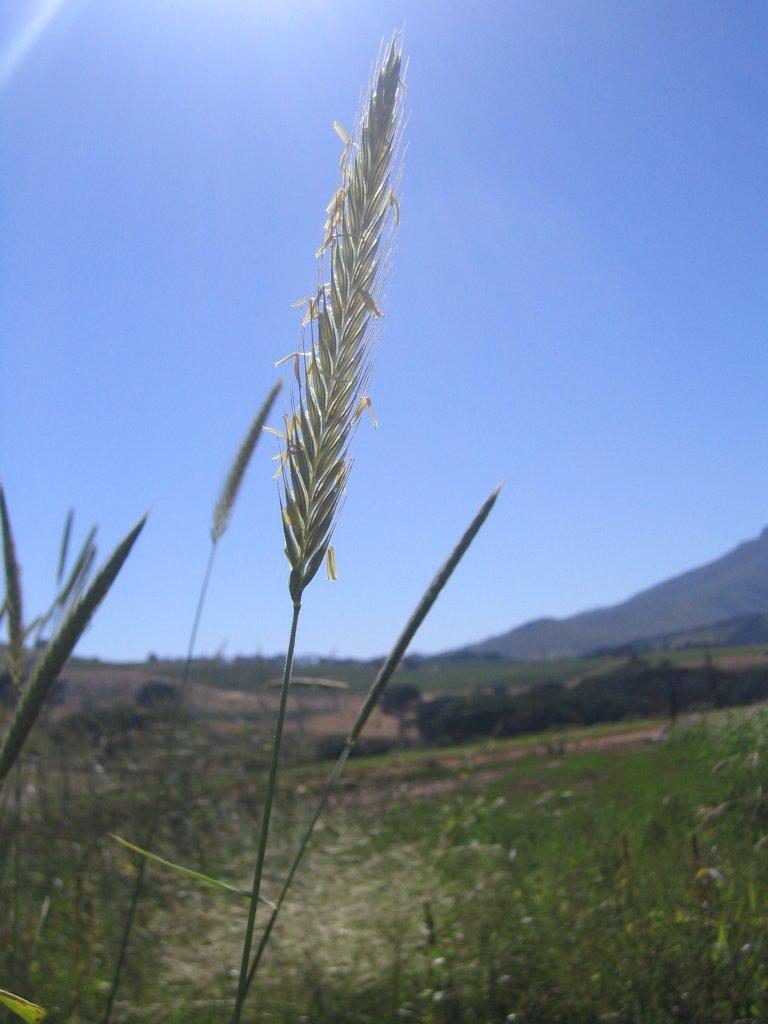
Wild rye (Secale africanum or Secale strictum (J.Presl) J.Presl subsp. africanum) is one such rare and endangered grass in South Africa. In the 20th Century, fewer than 50 individuals of the palatable perennial Roggras (as it is known in Afrikaans) were reportedly still surviving on only a few farms outside Sutherland, despite attempts by hares, birds, cattle and crop farmers (and the notorious cold) to wipe it out. Recently, another rare endemic and possibly endangered grass species (Helictotrichon roggeveldense) growing in the same area has been identified.

Wild rye / Roggras (Photo: Clement Cupido)

In the mid 1770s, the famous botanist traveller, Carl Thunberg  travelling through the Sutherland district noted that "These (Rogge Velds) … have been so named from a kind of rye, which grows wild here in abundance near the bushes.” William John Burchell (he of the eponymous zebra and coucal), however, noted less than 50 years later that “I saw none of the wild rye  which has been said to be so abundant as to give the name to this district [the Roggeveld region]; but this might be owing to the season of the year.” Thus, the steady demise of our only wild rye species appeared to have begun already by then.

But all is not lost. Nelmarié Saayman, a researcher from the Western Cape Department of Agriculture, and her colleagues have examined the feasibility of replanting cultivated Wild rye plants or seeds (along with other key species) into old crop lands in the Roggeveld district.  Their research revealed that roggras germinates well in the nursery and planted tufts and germinating seeds will survive in fields when planted at the start of the wet season and if protected from livestock and other wild herbivores until established.
 
Cultivated Rye grass (Photo: Clement Cupido)

Although specific efforts to rescue grasses facing extinction are laudable and necessary, the most effective means of conserving all the numerous and diverse type of plants occurring in indigenous grassland in the long-term will be to focus efforts on developing and implementing management procedures that maintain the overall health and integrity of our grasslands so they continue to deliver irreplaceable ecosystem goods and services to man and other beasts.


(From: www.http://wallpapertree.com)